Why it happens
Atmospheric layers are distinguished mainly by how temperature changes with altitude. Most weather occurs in the troposphere, while absorption of ultraviolet radiation helps warm the stratosphere above it.
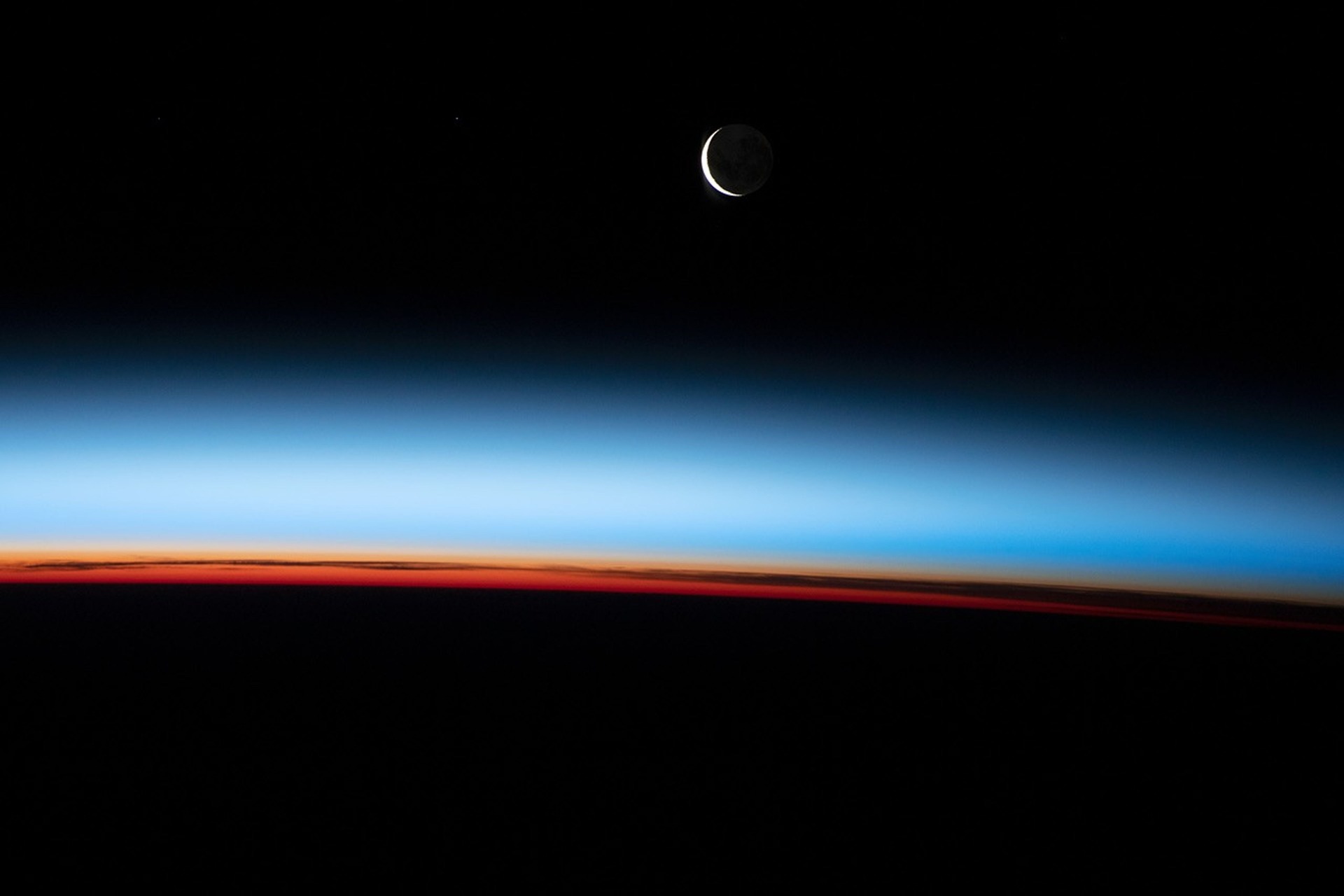
Earth's atmosphere seen edge-on from the ISS on 6 December 2021. Its coloured bands reveal a thin envelope above the surface.Try a comparison
Open Temperature profile. At lapse rate 6.5 °C/km, calculate 15 − 12 × 6.5 = −63 °C. Change the lapse rate to 4 °C/km and compare −33 °C.
Reading the result
Layer boundaries vary with place and season; the atmosphere is drawn thicker so its vertical structure can be inspected.
Film
Loading video player
The film stays paused until you play it.
What Does the Atmosphere Do? Crash Course Geography #6 — Crash Course.
A common misunderstanding
The tropopause is the top of the atmosphere.
The tropopause marks the boundary between the troposphere and stratosphere. Air continues far above it, becoming progressively less dense. Atmospheric layers are defined mainly by temperature structure, while the tropopause’s height changes with latitude, season and weather.
Troposphere
The lowest atmospheric layer, containing most air mass and nearly all weather. It is typically about 8 km deep near the poles and 16–18 km near the tropics.
Earth's thin atmosphere above the limb, photographed from the ISS on 6 December 2021. Scattered sunlight reveals lower atmospheric layers; coloured bands are not precise altitude boundaries.Tropopause
The boundary between the troposphere and stratosphere, identified mainly by a change in the vertical temperature gradient. Its altitude varies with latitude and weather.
Lapse rate
The rate at which temperature changes with height in the atmosphere. An environmental lapse rate describes measured surrounding air; an adiabatic rate describes a rising or sinking parcel. An inversion occurs where temperature increases with height.
Balloon-borne radiosondes transmit measurements of the atmosphere. Profiles of temperature, humidity and pressure help locate inversions and estimate lapse rates.Stratosphere
The atmospheric layer above the troposphere, extending roughly to 50 km altitude. Temperature generally increases with height because ozone absorbs ultraviolet radiation. This stable layering limits the vertical mixing typical of the lower weather layer.
Mesosphere
The atmospheric layer roughly 50–85 km above the surface, in which temperature generally falls with altitude. Many meteors become luminous here.
Thermosphere
The very thin atmospheric layer above roughly 85 km where kinetic temperature generally rises with altitude as gases absorb energetic solar radiation. Much auroral activity occurs here.
An ISS photograph of aurora north of Antarctica. Energetic particles excite upper-atmosphere gases; the green light is emitted by the atmosphere, not reflected sunlight.Radiosonde
An instrument package carried by a balloon that measures atmospheric properties such as temperature, humidity and pressure as it rises. Tracking its position also reveals winds. A sounding is a vertical sample at a time and place, not a complete atmospheric map.
Ozone layer
A region of the stratosphere with a relatively high concentration of ozone. Absorption of ultraviolet radiation helps warm this layer and reduces the amount reaching the ground. It is a diffuse region of gas, rather than a solid protective shell.
NASA Ozone Watch and GEOS-5, 21 September 2023. The mapped ozone hole is a region of depleted stratospheric ozone; colour represents measured or analysed ozone, not a visible opening.