Teachers
A lesson for your classroom or geography club
Geologic time
All teacher notes · Open the lab
A suggested lesson sequence
Use these stages at your own pace. Pause for students to sketch, compare observations or lead part of the demonstration.
01
Observe
Start at the oldest end of the full Earth-history window.
02
Tinker
Move towards the present, then enlarge Phanerozoic or Quaternary time.
03
Explain
Choose two intervals and compare their durations. How does enlarging a time window change which details you can see?
04
Check
Choose an answer and explain your reasoning. Each question includes feedback.
Rehearse with the model
The same scene and controls as the lab. Load it when you are ready; use Start projector for the full classroom view.
Before the lesson
Read dates in millions of years and compare the unequal durations of major intervals in Earth’s history.
Open the model before the lesson and choose a view that makes the important feature easy to see. Drag to rotate, and use the on-screen controls to change one variable at a time. The Controls panel explains the available keyboard shortcuts.
Ask students to predict the result before you change a setting. Compare the new view with the starting state.
Guide the demonstration
Start at the oldest end of the full Earth-history window.
Move towards the present, then enlarge Phanerozoic or Quaternary time.
Discuss a common misconception
“The Grand Canyon is as old as the rocks exposed in its walls.” The rocks formed before erosion exposed them in the canyon. Rock formation, deformation, uplift and river incision belong to different parts of the geological history and require different evidence to date. An old rock can therefore form the wall of a much younger landform.
Build the explanation
Earth’s history spans about 4.54 billion years. Placing events on a proportional timeline shows how recent human history is and why a short interval near the present can hide much older events.
Move towards the present, then enlarge Phanerozoic or Quaternary time.
The timeline is a scale for comparing ages; event dates have different uncertainties and should not all be read as equally precise.
Teaching notes
Read the numerical dates rather than the width of an event marker to judge its duration.
Distinguish the coiled time display from a column showing the thickness of real rocks.
Explain that enlarging a time window changes the display scale without changing how long the events lasted.
Check understanding
Open Check for 4 questions. Ask students to explain their choice before revealing the answer.
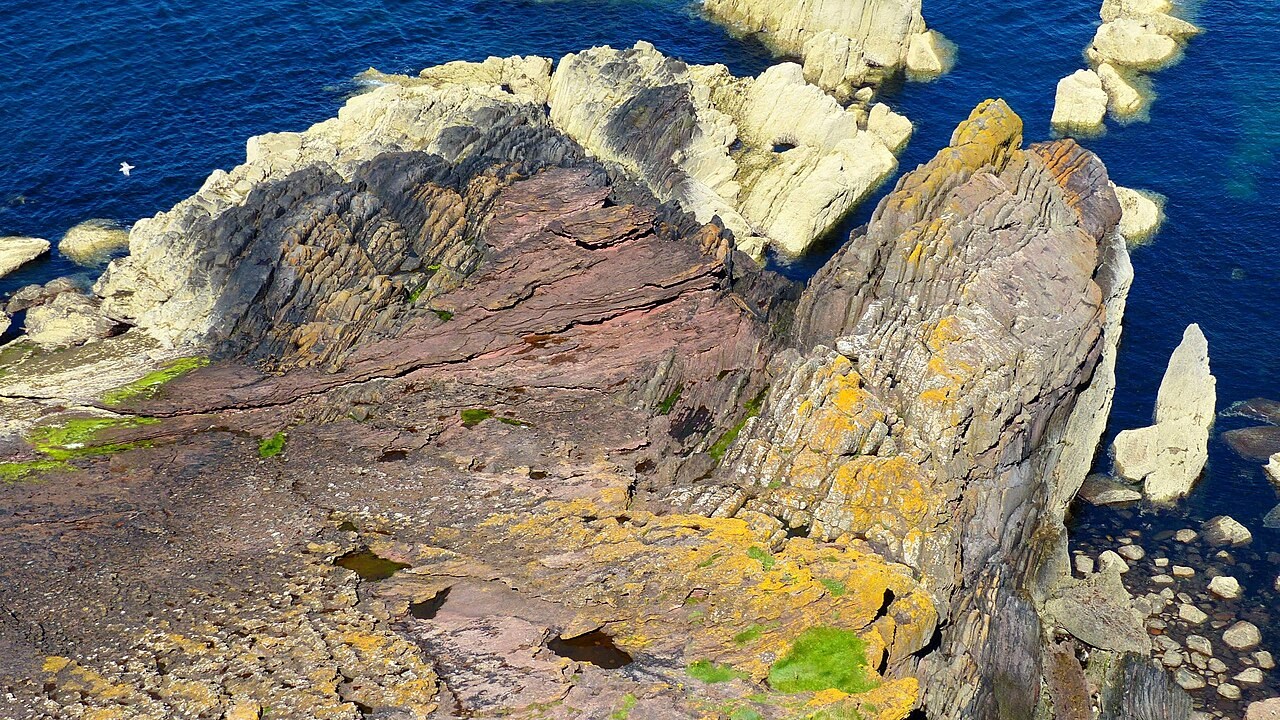
Return to the opening photograph. Ask students to identify one visible feature and explain which part of the model helps account for it.
Look more closely
Use these observations to connect the vocabulary to features students can identify.
ka
Pangaea
Sources to keep beside the lesson
- USGS geologic time
- BGS
- ICS International Chronostratigraphic Chart · 2026/06